
Showing all 3 results
-
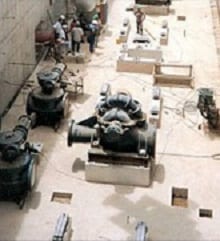
CEM310
High Performance Non-Shrink Cementitious Grout
-
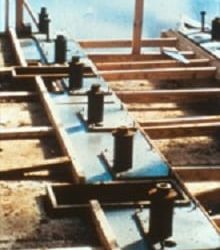
CEM982
High Performance Expansion Controlled Cementitious Grout, 2% Restricted and 5% Non-restricted Expansion
-
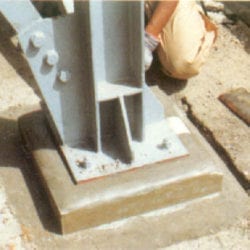
CHEM-POXY GROUT E999
Three Component High Strength Structural Epoxy Grout
A base plate that isn’t fully supported is a failure waiting to happen. Under a turbine, a crane rail, or a bridge bearing, even a small void beneath the plate concentrates load onto a fraction of the surface it was designed to spread across, and over time that concentrated stress cracks concrete, loosens bolts, and throws heavy equipment out of alignment. International Chem-Crete’s Structural Grouts line completely closes that gap, giving engineers and contractors a grout for every kind of base plate grouting, machinery installation, and structural connection that has to carry real load from day one.
Epoxy Grout for the Heaviest Loads
When a structure faces constant dynamic loading, high heat, or aggressive chemical exposure, cementitious grout isn’t always enough. That’s where CHEM-POXY GROUT E999 comes in. It’s a three-component, solvent-free, 100% solids epoxy grout engineered for exactly this kind of demand: high-speed turbines and centrifuges, bridge bearings, crane and transport rails, tie bars, and new or old machine base plates.
As an epoxy grout, E999 brings advantages cementitious systems can’t match. It’s moisture-insensitive, ultra-low creep, and highly flowable down to clearances as tight as 13mm, with compressive strength reaching nearly 17,000 psi and heat resistance up to 97°C. For base plate grouting under heavy dynamic or static loads, that combination of strength and flow means the epoxy grout fills every void under the plate, not just the ones that are easy to reach.
Controlled Expansion Grout for Precision Alignment
Not every application calls for epoxy. CEM982 is a controlled expansion grout built specifically for projects where precise, predictable movement matters as much as strength. It’s a ready-to-use, one-component, cementitious grout engineered with a two-stage expansion system, delivering 2% restricted and 5% non-restricted expansion in both its plastic and hardened states.
That controlled positive expansion makes CEM982 ideal for precision alignment work: machinery bases, train rails, subway rails, gantry cranes, and equipment bases in power plants, paper mills, and water treatment facilities. With compressive strength reaching more than 13500 psi at 28 days, CEM982 qualifies as a high-compressive-strength grout in its own right, and its high-sulfate-resistant cement formulation makes it a strong fit for humid or corrosive environments like food processing plants and sewage treatment facilities.
Non-Shrink Construction Grout for Everyday Structural Work
For general-purpose structural grouting where shrinkage simply can’t be tolerated, CEM310 fills that role. It’s a ready-to-use, one-component, flowable grout that complies with ASTM 1107 Type B, formulated with an inorganic shrinkage-compensating additive that keeps the mix dense and dimensionally stable from initial set through final cure.
As a non-shrink construction grout, CEM310 is used to grout structural columns, heavy machinery bases, post-tensioning cables, anchor bolts, precast T-joints, and bearing plates, along with large-scale repairs to damaged concrete structures and honeycombing. It reaches compressive strength over 11,000 psi at 28 days, remains stable under compressive loading, impact, and continuous vibration, and resists oil and water penetration once cured.
Choosing the Right Flowable Grout for the Job
All three products in this category share one property that makes them practical on real job sites: each is available as a flowable grout, capable of being poured or pumped into tight voids and hard-to-reach cavities without segregating or leaving air pockets behind. Flowability alone doesn’t decide the right product for a project, though:
- Epoxy grout (E999): the right choice where chemical resistance, heat, and dynamic loading are the priority
- Controlled expansion grout (CEM982): the right choice where alignment precision matters as much as load-bearing strength
- Non-shrink construction grout (CEM310): the right choice for the everyday structural grouting work that makes up most job sites
For highway departments, contractors, and engineers specifying grout for infrastructure that must perform for decades, that distinction isn’t academic. Base plate grouting done with the wrong product shows up fast: loosened bolts, cracked pedestals, and equipment slowly drifting out of alignment. Getting the grout right the first time protects the investment sitting on top of it.
Frequently Asked Questions
Que : What’s the difference between an epoxy grout and a cementitious grout like CEM310 or CEM982?
Ans : Epoxy grout (E999) offers higher chemical and heat resistance with ultra-low creep, suited to heavy dynamic loads. Cementitious grouts like CEM310 and CEM982 are more economical for general structural grouting and precision alignment work.
Que : When should a controlled expansion grout be used instead of a standard non-shrink grout?
Ans : Use a controlled expansion grout like CEM982 when precise, predictable movement is critical, such as aligning machinery bases or rails. A standard non-shrink grout like CEM310 suits general base plate grouting where alignment precision isn’t the priority.
Que : Can these grouts be used for large-scale repairs, not just base plate grouting?
Ans : Yes. CEM310 and CEM982 both work in large-scale shuttered repairs, including retaining walls, column extensions, and honeycomb repairs, beyond their standard base plate and machinery grouting use.
Que : Does CHEM-POXY GROUT E999 need special conditions to cure properly?
Ans : Yes. E999 shouldn’t be applied below +10°C, and the substrate moisture content must stay under 5%. Under proper conditions, it reaches final cure within 7 days.
Que : How much weight can these grouts support once cured?
Ans : E999 reaches close to 17,000 psi, CEM982 nearly 13,500 psi, and CEM310 over 11,000 psi at 28 days, all suited to demanding structural applications like turbines, cranes, and machinery bases.