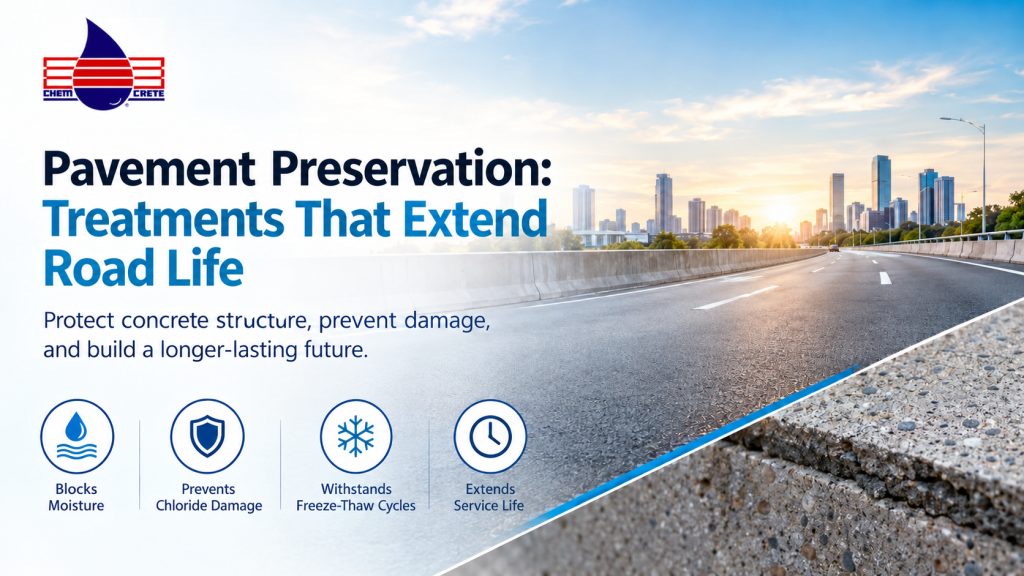
Roads and paved surfaces must handle a lot: heavy traffic, changing temperatures, rain, moisture, deicing chemicals, freeze-thaw cycles, and the everyday wear from thousands of vehicles passing over them. Yet even durable pavement has a breaking point.
The good news? Road deterioration doesn’t have to become a repair emergency before you act.
That is where Pavement preservation comes in. Instead of waiting for major cracking, spalling, water intrusion, or other damage to appear, preservation focuses on fixing the conditions that contribute to deterioration in the first place. For transportation agencies, municipalities, contractors, engineers, and property owners, this approach can help protect valuable infrastructure and support longer service life.
What Is Pavement Preservation?
Simply put, pavement preservation is a proactive approach to maintaining pavement before extensive deterioration requires major rehabilitation or replacement.
A preservation program may involve treatments designed to address specific threats, including:
- Water and moisture intrusion
- Chloride penetration from deicing salts
- Freeze-thaw cycling
- Ice adhesion
- Concrete permeability
- Alkali-silica reaction (ASR)
- Corrosion of reinforcing steel
- Surface deterioration and weathering
The exact treatment depends on the pavement material, its current condition, environmental exposure, and the mechanism contributing to deterioration.
Why Waiting for Damage Can Be Expensive
Concrete and asphalt rarely fail overnight. Deterioration often develops gradually, sometimes beginning with processes that aren’t immediately visible.
Water can move through pores and capillaries. Chlorides can penetrate concrete and contribute to reinforcing steel corrosion. Repeated freezing and thawing can contribute to cracking, scaling, and spalling. Over time, relatively small problems can become much more expensive maintenance projects.
This is why Pavement preservation treatment is fundamentally different from simply repairing visible damage.
Understanding the Threat: Water Is More Than Just Water
When people think about pavement deterioration, traffic is usually the first culprit that comes to mind. But environmental exposure deserves plenty of attention, too. Water can enter concrete through its pore structure and microscopic pathways. Once moisture is present, other deterioration mechanisms can become more challenging.
In cold climates, repeated freezing and thawing can place extra stress on concrete. In areas where deicing salts are commonly used, chloride ions can penetrate concrete and contribute to reinforcing steel corrosion. Chem-Crete’s concrete protection technologies address issues such as moisture, chloride penetration, freezing, ASR, and corrosion.
In other words, pavement preservation isn’t simply about making a surface look better. It is about understanding how environmental exposure interacts with the material beneath the surface.
Different Pavements Need Different Strategies
One of the biggest mistakes in infrastructure maintenance is assuming that every pavement can be treated the same way. Concrete and asphalt have different material characteristics and deterioration mechanisms. As a result, the preservation strategy should reflect the pavement type.
For concrete pavement, preservation may focus on:
- Reducing permeability
- Limiting water and moisture movement
- Addressing chloride penetration
- Improving resistance to freeze-thaw exposure
- Managing ice adhesion
- Protecting reinforcing steel
- Reducing conditions associated with ASR
For asphalt pavement, a compatible treatment is needed because asphalt has a different chemistry and performance profile. Chem-Crete offers a silicone-modified asphalt sealer specifically formulated for asphalt pavement applications, while its concrete preservation technologies use different approaches.
The lesson is simple: the right treatment starts with the right diagnosis.
Surface Treatments vs. Integral Protection
Not every preservation solution is applied in the same way. Some treatments are applied to existing or newly placed concrete surfaces. Others are incorporated into the concrete mix before placement.
For example, CHEM-CRETE MCE is a multi-crystalline permeability-reducing admixture added to fresh concrete. By addressing permeability from within the concrete matrix, it is intended for durability-focused new construction.
Other technologies, such as PAVIX CCC 100, are topical treatments designed for green or cured concrete. The product is positioned for applications including highway pavements, airport runways, and bridge decks where protection against water and moisture-related deterioration is important.
For asphalt pavement applications, CHEM-CRETE ASP provides a treatment and protection solution suitable for both new and existing asphalt pavements. Including an asphalt-specific product in a pavement preservation strategy helps address the different material characteristics of asphalt compared with concrete, allowing infrastructure professionals to select a solution suited to the pavement type and project requirements.
This distinction matters when planning a project:
- New construction? Consider protection during the concrete batching stage.
- Existing pavement? Look for preservation treatments compatible with cured, in-service concrete.
- Asphalt pavement? Select a solution designed specifically for asphalt.
What Makes an Effective Pavement Preservation Program?
A successful preservation strategy isn’t about applying a product and forgetting about the pavement. It involves understanding the asset, its environment, and its expected service conditions.
A practical evaluation can consider:
- Pavement type: Is it concrete or asphalt?
- Current condition: Are there visible cracks, scaling, spalling, or other deterioration?
- Environmental exposure: Is the pavement exposed to freeze-thaw cycles, deicing salts, standing water, or high humidity?
- Traffic demands: What level and type of traffic does the pavement experience?
- Timing: Is the project new construction, maintenance of cured pavement, or part of a broader rehabilitation program?
- Targeted deterioration mechanism: What problem are you actually trying to prevent or slow?
Concrete Structures Need Protection, Too
Pavement preservation is only one part of a larger infrastructure strategy. Roads often exist alongside bridges, parking structures, airports, tunnels, water infrastructure, and other concrete assets.
That makes concrete structure protection an important part of long-term infrastructure management.
Concrete protection technologies can be designed to address water and vapor movement, permeability, chloride exposure, corrosion, biological attack, freeze-thaw damage, and other durability concerns. International Chem-Crete’s broader protection range includes waterproofing, sealing, repair, grouting, hardening, and coating solutions for different concrete applications.
Preservation Today, Fewer Surprises Tomorrow
Nobody enjoys discovering that a familiar road needs major rehabilitation, especially when the project means traffic disruptions, increased costs, and long planning timelines.
Preservation offers a more proactive alternative.
By identifying deterioration mechanisms early and selecting treatments suited to the pavement and environment, infrastructure professionals can work toward maintaining performance rather than constantly responding to failure.
That protect-first philosophy is central to Chem-Crete’s approach to pavement and concrete protection, backed by decades of experience in developing technologies for infrastructure durability.
FAQs
- What is pavement preservation?
Pavement preservation is a proactive maintenance approach to protect pavement before significant deterioration occurs. Treatments can target issues such as moisture intrusion, chloride penetration, freeze-thaw exposure, permeability, and other deterioration mechanisms.
- What is a pavement preservation treatment?
A pavement preservation treatment is a product or maintenance method to protect pavement and slow deterioration. The right treatment depends on factors such as pavement material, existing condition, environmental exposure, and the specific mechanism causing potential damage.
- How does moisture affect concrete pavement?
Moisture can enter concrete through pores and capillaries and contribute to deterioration. Along with freezing, deicing salts, or other environmental factors, moisture can lead to problems such as scaling, cracking, spalling, and reinforcing steel corrosion.
- Can pavement preservation be used on existing roads?
Yes, certain preservation technologies are specifically formulated for existing, cured pavement. For example, PAVIX CCC 100 is designed for application to cured as well as green concrete, making it suitable for certain existing pavement preservation.
- Is concrete preservation different from asphalt pavement protection?
Yes. Concrete and asphalt have different material properties and deterioration mechanisms, so they require compatible preservation strategies. Treatments should be selected as per the pavement type and the specific conditions the surface is expected to withstand.